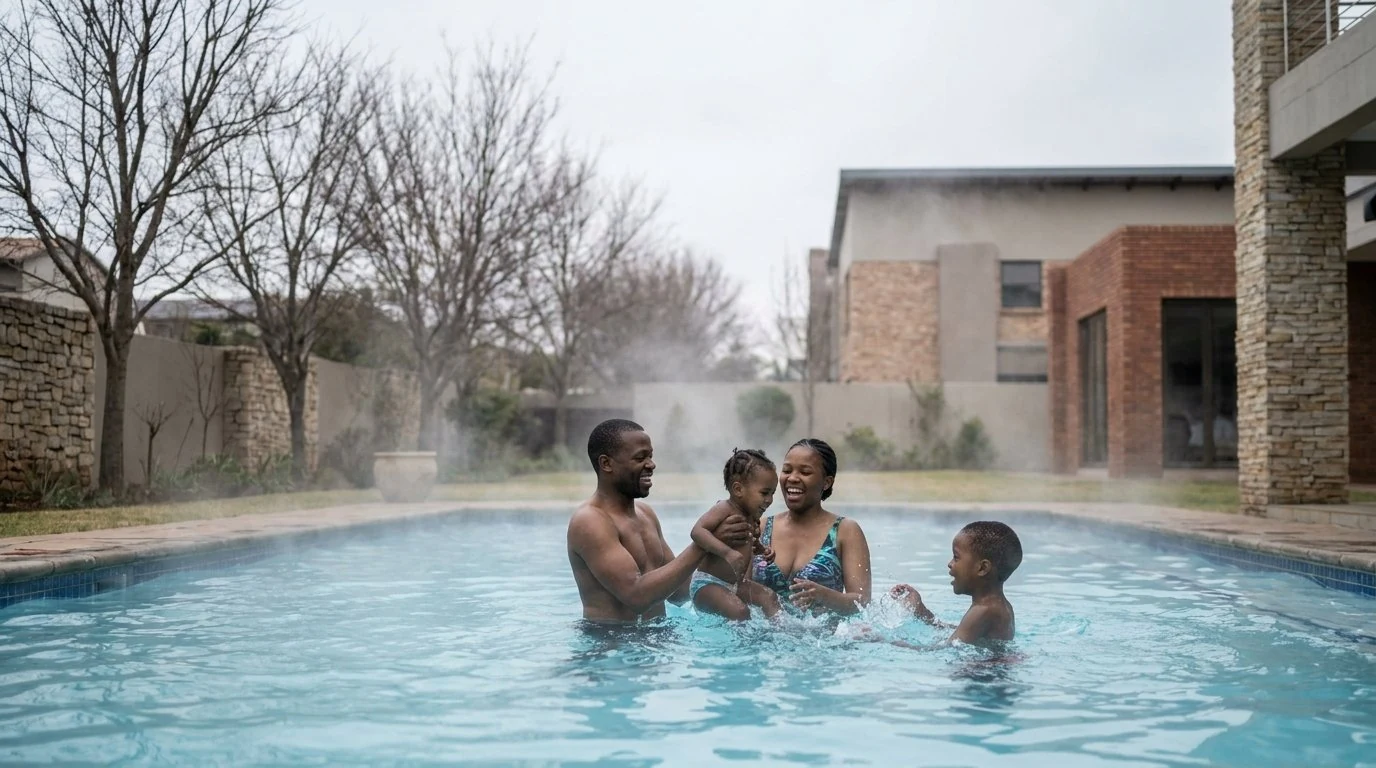
Everyone asks what a pool costs to build. Far fewer ask what it costs to keep running — and that's the number that catches owners out. A pool you paid R150,000 to install can quietly cost you R1,500 to R3,500 a month to keep clean, warm and topped up. Here's the honest rand breakdown for 2026, and where each cost can be cut.
We don't sell pools, pumps or chemicals. These figures are typical South African ranges — your own bill depends on pool size, equipment age and how you run it.
What will your pool cost to run?
A working monthly estimate in 2026 rands. Adjust the inputs — pump electricity is usually the biggest driver.
Independent estimate for a private pool. Excludes once-off repairs and equipment replacement. Tariffs vary by municipality — adjust the rate. Figures in 2026 ZAR.
The four running costs
Pool running cost comes from four places: the pump's electricity, chemicals, water lost to evaporation, and heating if you want to swim past summer. Most owners only notice the first when the Eskom bill lands.
1. Electricity — the pump is the big one
The circulation pump is usually the largest single running cost. A standard pump running the recommended 8 hours a day is a meaningful slice of a household's electricity bill. The practical rule: all the water should pass through the filter at least once every 24 hours — roughly 8 hours for a correctly sized pump on an average pool.
Two levers cut this immediately:
- Run time. Trimming pump run time by one hour a day saves in the region of R680 a year. In summer your pool needs more filtering; in winter you can scale back an hour at a time and watch the water.
- Avoid peak. Set the timer to run outside 17:00–21:00, the national peak demand window. It doesn't save you money directly, but it eases the grid and suits time-of-use tariffs.
- Pump type. A variable-speed pump uses far less than an old single-speed motor for the same filtration. The upgrade pays back over a few seasons on a heavily used pool.
After load shedding, check your timer — an outage often resets it, leaving the pump running at the wrong hours.
2. Chemicals and maintenance
Sanitiser, pH balancers and the odd top-up of stabiliser add up. Owners who do their own dosing spend less; a service plan costs more but takes the job off your hands. Across chemicals and routine maintenance, budget roughly R1,500 to R3,000 a month depending on pool size and whether you DIY or use a service. A smooth surface (fibreglass) and a cover both cut chemical use — fewer contaminants, less sun degrading your chlorine.
3. Water — evaporation you're paying for twice
An uncovered pool loses a surprising amount of water to evaporation — on the order of hundreds of litres a week in a Highveld summer. You pay for that twice: once to refill, and again in the chemicals you add to the new water. A thermal blanket is the cheapest way to stop most of it.
4. Heating — the cost of swimming past March
An open pool sits cold and unused for roughly half the year. Heating changes that, and the running cost depends entirely on the method:
- Solar panels — close to free to run once installed; the sun does the work.
- Heat pump — uses electricity, but a fraction of what a resistive element would; holds a set temperature through winter.
- Electric element — fast, but the most expensive way to heat water; avoid for a whole pool.
If you're weighing these up, our pool heating guide breaks down the costs and how to choose.
How to cut your running cost
In order of return on effort:
- Fit a solar blanket. Cheapest upgrade, biggest combined saving — less evaporation, less heat loss, fewer chemicals.
- Right-size and schedule the pump. Correct run time, off-peak timer, and a variable-speed motor on a busy pool.
- Heat with solar, not an element. Free running cost once it's in.
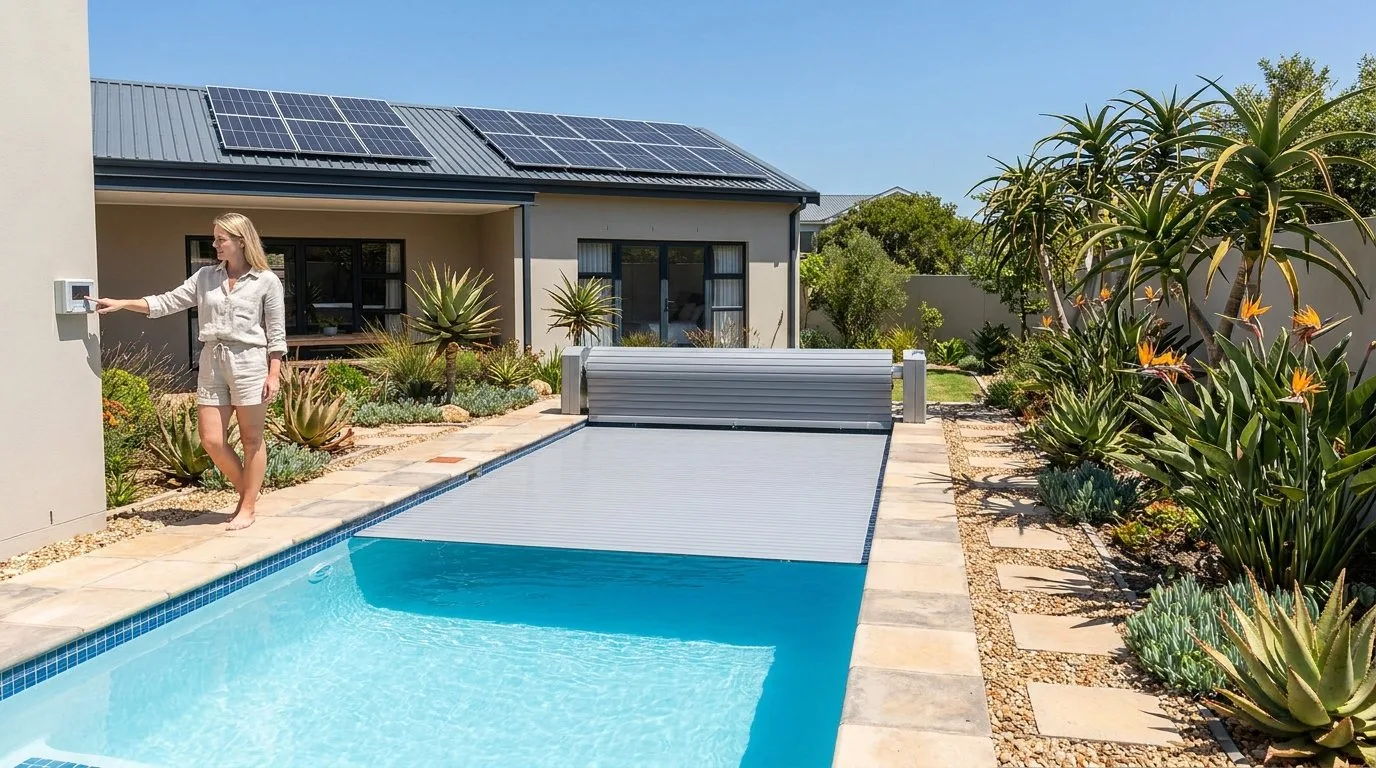
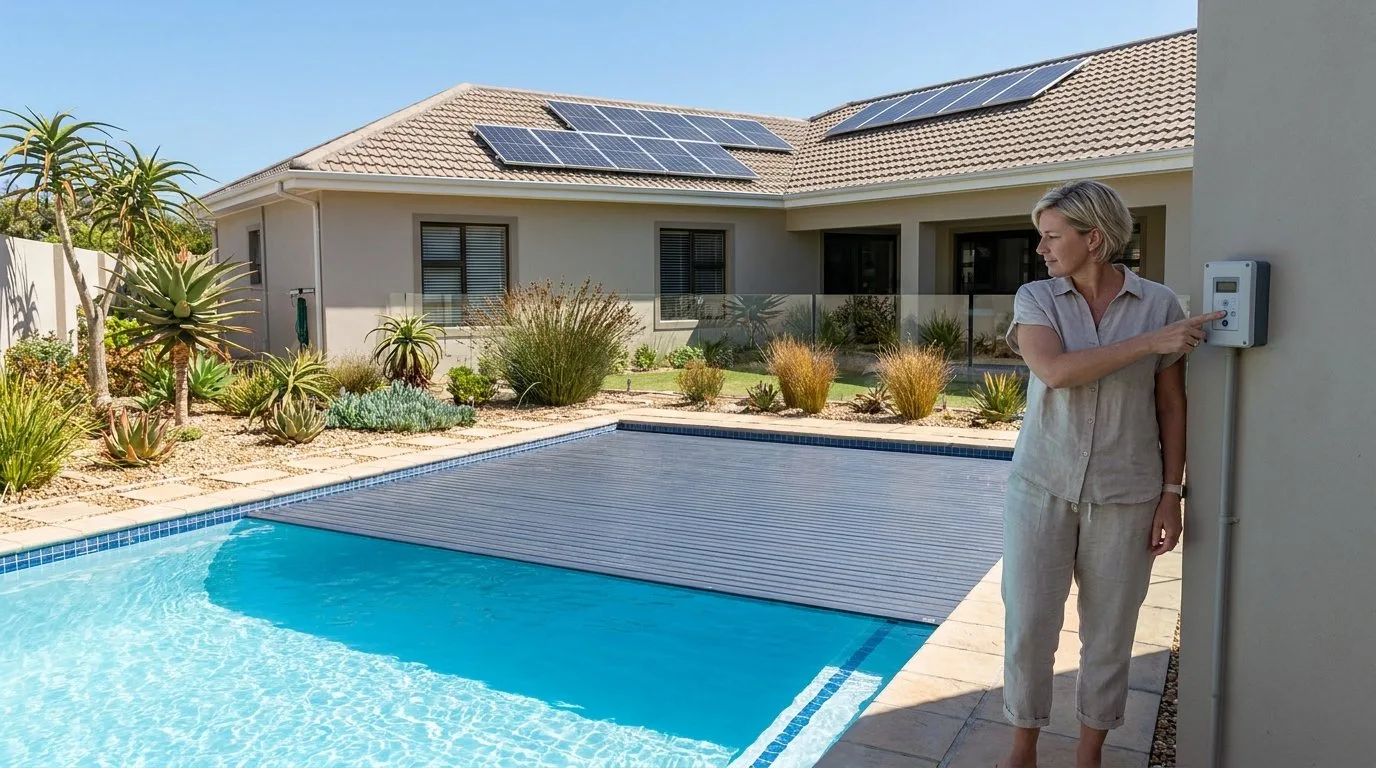
- Cover the pool when it's not in use. A safety or automatic cover does the same heat-and-evaporation job as a blanket and adds child and pet safety.
On covers specifically: a thermal blanket warms and saves water; a safety or automatic cover does that and stops a child or pet falling in, as encouraged under South Africa's building regulations. For automatic and safety covers, see our pool covers hub for the recommended specialist.
The bottom line
A South African pool typically runs to R1,500–R3,500 a month before heating, and most of that is pump electricity and chemicals. Nearly all of it is reducible: a blanket, a sensibly scheduled efficient pump, and solar heating turn a pool from a money drain into something you actually use ten months of the year.
For what a pool costs to build rather than run, see our pool cost matrix and the SA Pool Cost Index.
Figures are typical 2026 ranges for guidance, not quotes. Get a measured quote for your pool and equipment.