
Building a Swimming Pool in Cape Town: 2026 Cost & Site Guide
Key takeaway: Cape Town pool building is shaped by three forces — the City's water by-laws (a legacy of Day Zero), the southeaster wind, and steep, rocky topography. Costs vary more by site than in any other SA metro.
The Day Zero legacy and current water rules
Even with dams above 80% in normal years, the City of Cape Town Water By-law contains permanent restrictions: every pool must have a cover that significantly reduces evaporation; filling a new pool from potable supply may require written City permission; manual hosing of pool surrounds is restricted; and metered top-up volumes are monitored.
Practical implications for a new build: plan a 5,000–10,000L rainwater tank into your budget; get tanker fill quotes (a 4×8m pool holds 32,000–40,000L; tanker fills run R2,500–R5,500 per truck); specify a SANS-compliant cover from day one.
The southeaster and pool design
Cape Town's summer southeaster blows at 50–80 km/h from November–February. A windy uncovered pool loses 8–12mm/day in summer — over 40,000L/year for a 4×8m pool. Fynbos and Port Jackson debris fill skimmers daily. Standard floating solar blankets are blown off in any breeze — a reel-mounted cover or slatted automatic cover is the practical Cape choice.
Why Hout Bay and Llandudno builds run R450k–R850k+
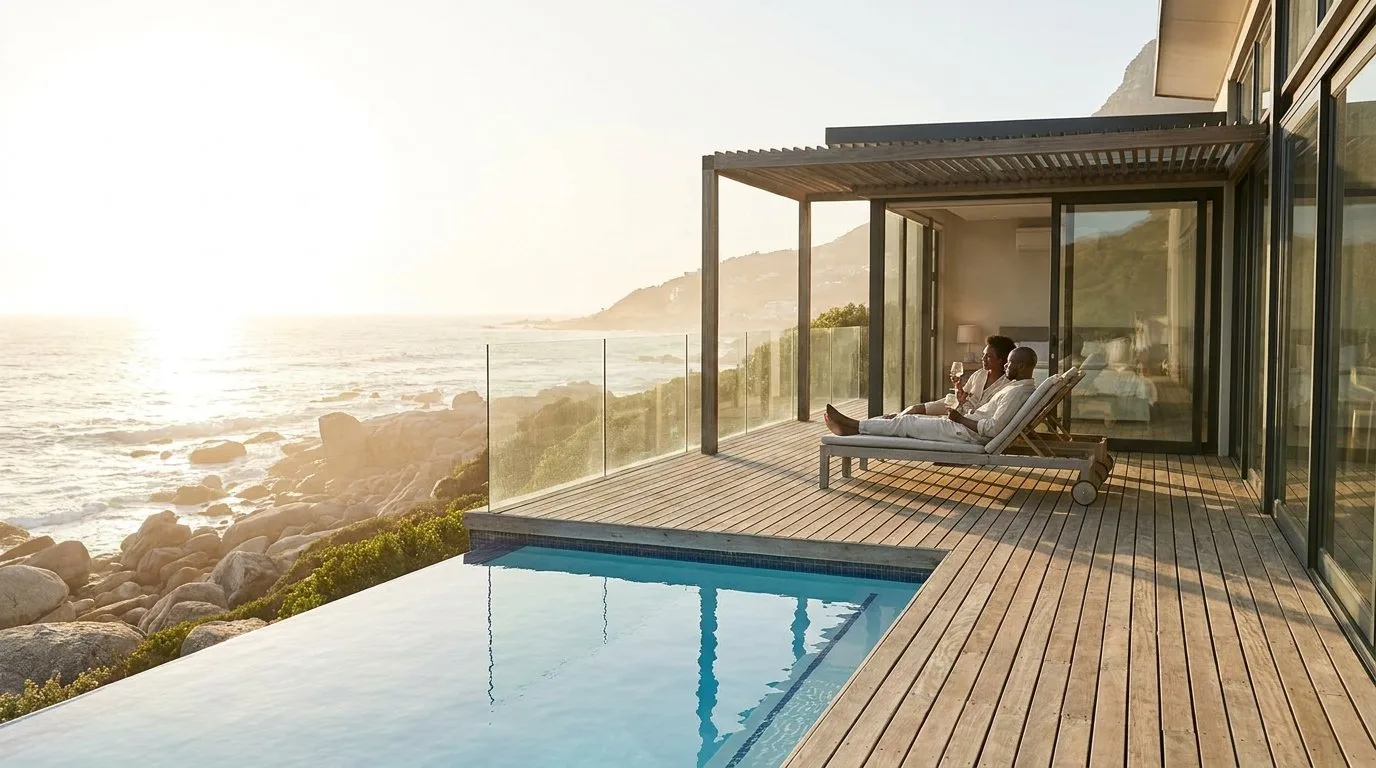
Steep slopes, narrow access streets, engineered retaining walls and 100-tonne crane requirements regularly add R150,000–R450,000 to a base pool budget. Atlantic Seaboard sites also frequently require crane standing space across the road, adding R25,000–R60,000 in logistics alone.
Reviewed January 2026 · By the Swimming Pool Builders Editorial Team