Foundations · West Rand · Centurion · Pretoria East
Dolomite Pool Build Checklist — South Africa (2026)
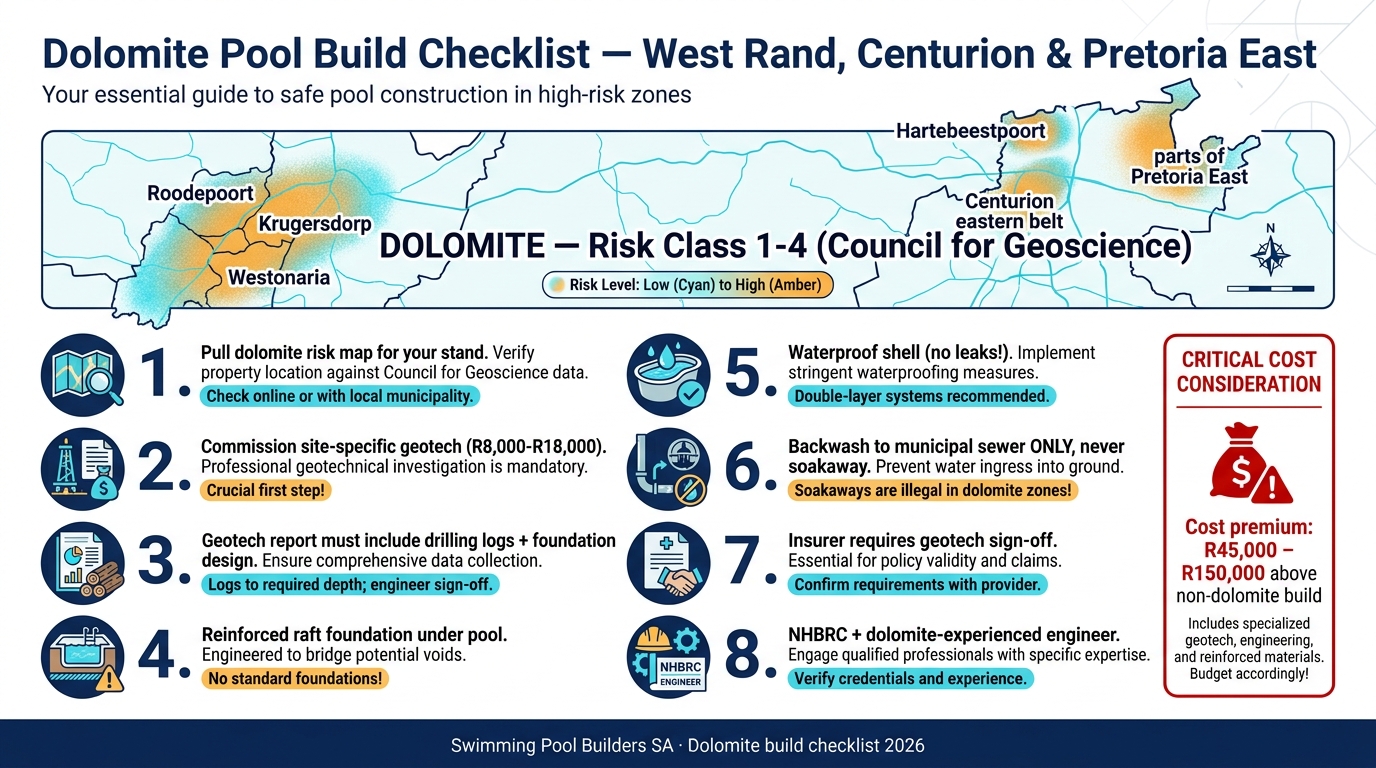
Gauteng's dolomite belt is one of the most concentrated geotechnical hazards in South African residential construction. The risk isn't theoretical — the Council for Geoscience maintains a public mapping of stability classes precisely because sinkholes form where uncontrolled water enters dolomitic ground. A swimming pool concentrates two of the highest-risk factors on one stand: tens of thousands of litres of water, and decades of slow seepage from joints, fittings and backwash lines. This checklist is the independent eight-step process every dolomite-zone homeowner should run before signing a build contract.
The 8-step pre-build checklist
- 1
Pull the dolomite risk map for your stand
Verify the property's classification against Council for Geoscience dolomite-stability mapping (Risk Class 1–4). Most municipalities will provide a desktop indication free of charge; high-risk zones include the West Rand (Roodepoort, Krugersdorp, Westonaria), Centurion's eastern belt, Hartebeespoort and parts of Pretoria East.
- 2
Commission a site-specific geotechnical investigation
Budget R8,000–R18,000 for boreholes, percussion testing and a formal geotech report. A municipal desktop classification is not a substitute — your stand can sit one risk class higher (or lower) than the suburb average.
- 3
Require drilling logs plus a foundation design
The geotech report must include borehole logs to the depth specified by the engineer and a foundation recommendation signed off by a registered professional engineer (Pr.Eng or PrTechEng). Refuse builders who quote without it.
- 4
Engineer a reinforced raft foundation under the pool
Standard pool foundations are not acceptable in dolomite-risk zones. A reinforced concrete raft is designed to bridge potential voids and distribute load. This typically adds R45,000–R150,000 to the build versus a non-dolomite site.
- 5
Specify a waterproof shell with double-layer protection
Water ingress is the primary trigger for sinkhole formation. Specify a fully waterproofed concrete shell with bond-coat, screed and approved waterproof finish — double-layer systems are recommended on Class 3–4 sites.
- 6
Route backwash to municipal sewer ONLY — never to soakaway
Soakaways concentrate water into the dolomite and are effectively prohibited in risk zones. All filter backwash, deck drainage and overflow must discharge to the municipal sewer line with a permitted connection.
- 7
Get insurer geotech sign-off before signing the build contract
All major SA short-term insurers exclude sinkhole damage on dolomite stands without a current geotech report and engineered foundation. Confirm in writing — your policy is otherwise void from the first fill.
- 8
Use an NHBRC-registered, dolomite-experienced engineer and builder
NHBRC registration is mandatory for residential construction. For dolomite work, verify the engineer's CV shows comparable Risk Class 3–4 projects, and the builder can produce sign-offs from those previous builds.
Frequently Asked Questions
This checklist is independent editorial guidance and does not constitute engineering advice. Always commission a registered professional engineer for site-specific design. See our editorial standards for sourcing and review process.